[Anchor]
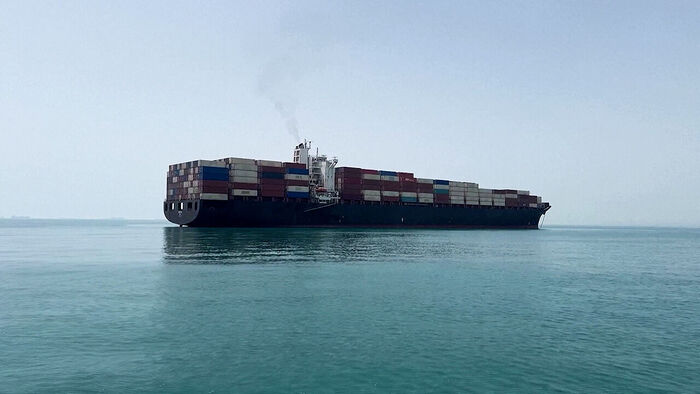
Following the ceasefire agreement between the United States and Iran, two more South Korean vessels have successfully exited the Strait of Hormuz. There are now 22 ships remaining.
Reporter Chae Hee-sun has the story.
[Reporter]
The Ministry of Oceans and Fisheries announced that two South Korean vessels, which had been stranded inside the Strait of Hormuz, have passed through the strait.
While owned by a South Korean shipping company, the vessels did not have any South Korean crew members on board, and their destination was identified as a third country, not South Korea.
This marks the first time a South Korean vessel has exited the strait since the U.S.-Iran ceasefire agreement, which allows for free passage through the Strait of Hormuz without transit fees for 60 days.
Specific details regarding the circumstances and background of their passage have not been disclosed.
With these two additional ships out, there are 22 South Korean vessels and 135 South Korean crew members still inside the Strait of Hormuz.
Shipping companies that have completed their transit applications with the Iranian Ports and Maritime Organization and are awaiting approval are feeling anxious, fearing that Iran might block the route again after its recent threats to re-close the strait.
[Shipping Company Official: We applied for our desired transit dates last week. Everyone is eager to get out as quickly as possible, so we are feeling nervous and waiting, unable to confirm (the transit schedule)...]
Even if they do manage to exit, there is already growing concern about what will happen after the 60-day window for free passage expires.
[Shipping Company Official: Even with this MOU, things keep changing, so it lacks credibility. Right now, it feels like they will impose a 100% (transit fee).]
Experts also believe that the possibility of additional costs cannot be ruled out.
[In Nam-sik, Professor at the Korea National Diplomatic Academy: The fact that the MOU mentions the sovereignty of the coastal state is somewhat unsettling. (After 60 days) they could come forward and demand some form of transit fee or service charge.]
A high-ranking government official reiterated the stance that "transit fees are highly likely to undermine international trade and the order of international law," adding that "transit fees should not be paid."
The government stated that it will continue to cooperate with relevant countries to ensure the safety and free navigation of South Korean vessels and crew members as soon as possible.
Reported by Chae Hee-sun | Video by Bae Moon-san | Video Editing by Wi Won-yang | Graphics by Lee Jong-jung | Produced by SBS Digital News
※ Please note: This article was translated by AI and may contain errors.
22 Ships Remain in Strait of Hormuz, Concerns Grow Over 'Post-60-Day' Period
Jun 23, 2026